Dry Storage in Riyadh: A 2026 Guide for Food & Retail Businesses
Behind every busy restaurant, grocery chain and food distributor in the capital sits an unglamorous hero: the storeroom. Rice, flour, canned goods, spices and packaged staples all need a home that keeps them dry, cool and pest-free for months at a time. That is where professional Dry Storage in Riyadh earns its place — protecting the shelf-stable backbone of your inventory while your fresh and frozen lines take the spotlight. In 2026, as Riyadh’s food sector scales fast, getting dry storage right is a margin decision, not a maintenance chore.
This guide covers what dry storage really involves, how it differs from frozen, and the habits that keep stock safe and sellable.
What Does Dry Storage Actually Protect Against?
Dry storage sounds simple, but it fights a constant battle against four enemies:
- Moisture — causes clumping, mould and rust on cans.
- Heat — shortens shelf life and degrades oils and grains.
- Pests — rodents and insects thrive on unprotected staples.
- Light — fades packaging and degrades sensitive contents.
A well-run dry store holds a stable, cool temperature — usually between 10°C and 21°C — with low humidity and tight sanitation. The U.S. Food and Drug Administration’s Food Code sets widely referenced benchmarks for dry-storage conditions and off-floor spacing; the guidance on the FDA website is a solid baseline even for operators outside the United States.
The Golden Rules of a Dry Store
- Keep everything at least 15 cm off the floor and clear of walls.
- Maintain first-in, first-out rotation to use older stock first.
- Store chemicals and cleaning supplies well away from food.
- Label and date every delivery on arrival.
- Check humidity and inspect for pests on a fixed schedule.
Dry vs Frozen: Two Very Different Worlds
Dry and frozen storage solve opposite problems, and confusing the two is costly. The comparison below shows how they differ in practice.
| Attribute | Dry storage | Frozen storage |
|---|---|---|
| Temperature | 10°C – 21°C | -18°C or below |
| Typical goods | Grains, cans, spices | Meat, seafood, ice cream |
| Shelf life | Months to years | Months if unbroken |
| Energy use | Minimal | Very high |
| Main risk | Moisture, pests | Thaw and refreeze |
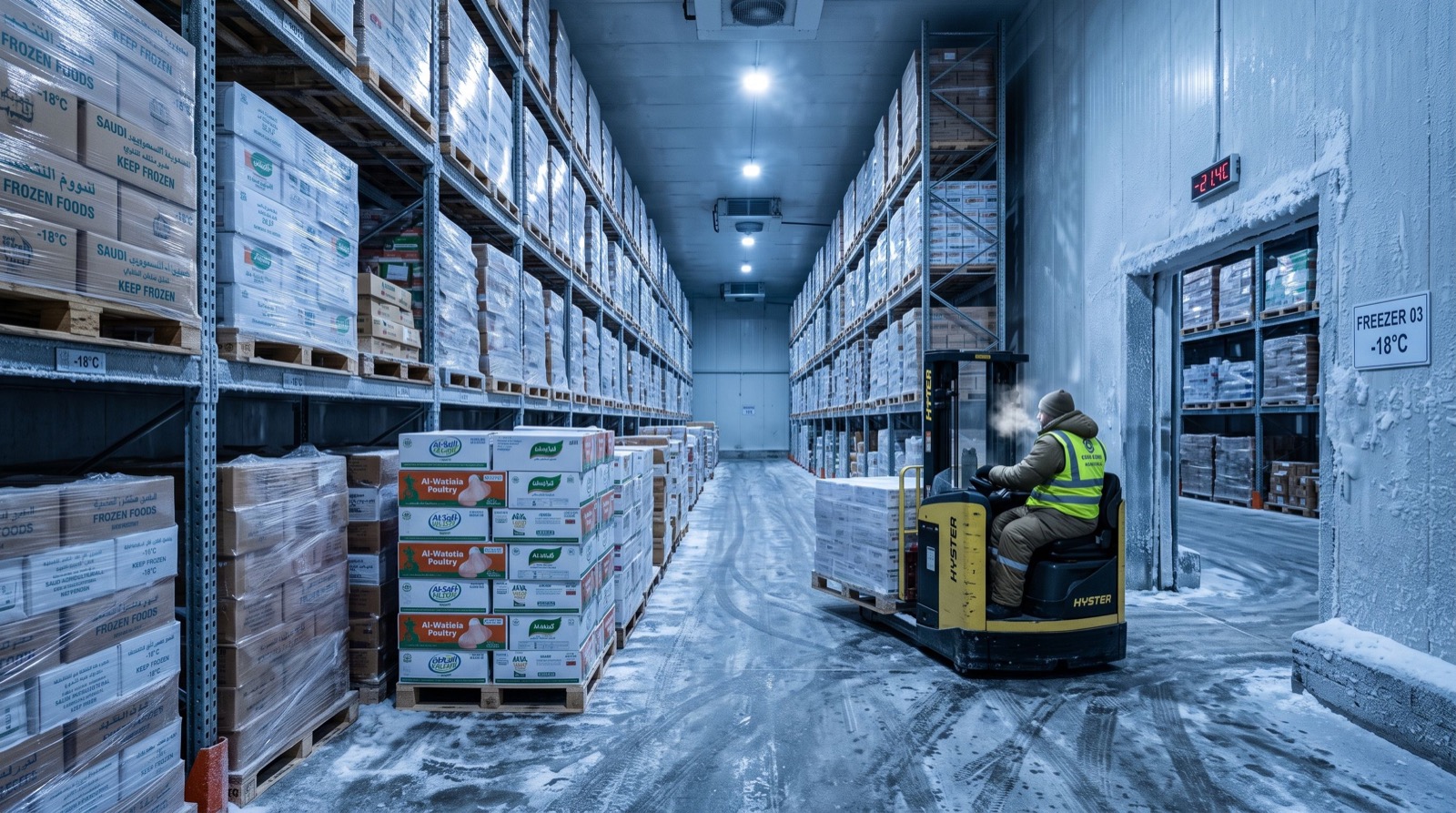
Perishable proteins and frozen desserts belong in dedicated deep-cold space. Reliable Frozen Storage in Riyadh holds these goods at -18°C and below, where a single thaw-and-refreeze cycle can render an entire batch unsafe. Most food businesses therefore run dry and frozen side by side, routing each product to the environment it demands.
How Much Dry Storage Does Your Business Really Need?
Space planning trips up many operators — they either overpay for empty racking or run out of room mid-season. A practical approach:
- Map your top 20 SKUs by volume and reorder frequency.
- Account for seasonal spikes like Ramadan and holiday catering.
- Leave clear aisles for safe forklift and trolley movement.
- Build in a 15–20% buffer for growth and bulk-buy savings.
Choosing flexible, scalable space means you can add capacity as you grow rather than committing to a warehouse you cannot yet fill.
Why Is the Cold Chain So Critical for Frozen Goods?
The cold chain is the unbroken sequence of freezing from production to plate. Break it once and food safety collapses. The International Institute of Refrigeration highlights how temperature abuse during handling drives spoilage and health risk; its technical work at the IIR knowledge base underlines that frozen storage is only as strong as its weakest transfer point.
This is precisely why dry and frozen storage are managed so differently. Dry goods forgive a warm afternoon; frozen goods do not. Treating them with a single blanket policy is a recipe for waste.
A Field-Tested Tip for Multi-Site Operators
If you run several outlets, centralise your dry staples in one well-managed hub and distribute in smaller batches. This reduces on-site clutter, tightens stock control and slashes the pilferage and spoilage that creep in when every branch hoards its own bulk supplies. Pairing that with reputable service experts for storage and transfer keeps the whole network lean.
Food Safety Habits That Separate the Best Operators
The difference between a store that passes every inspection and one that scrambles at the last minute comes down to daily habits, not expensive equipment. Food safety is built one small routine at a time.
Temperature checks top the list. Recording dry-store and freezer readings at set times each day catches drift before it becomes disaster, and the log itself becomes proof of diligence if a question ever arises. A cheap wall thermometer, checked religiously, outperforms an expensive system nobody monitors.
Cleanliness is the next pillar. Spills attract pests, and pests contaminate stock, so a wipe-as-you-go culture protects far more value than it costs in time. Sealed containers for opened bulk goods keep both moisture and insects out.
Finally, staff training turns rules into instinct. When every team member understands why staples sit off the floor and why frozen goods must never be left thawing on a dock, compliance stops being a checklist and becomes a shared standard.
Planning for Peak Season
Demand in Riyadh’s food sector is anything but flat. Ramadan, Eid and the wedding season send volumes soaring, and storage that copes in a quiet month can buckle under a peak. Forecasting these spikes and securing flexible extra capacity in advance keeps service smooth when it matters most. The operators who plan for peaks in 2026 are the ones who never turn a customer away for being out of stock.
Frequently Asked Questions
What temperature should dry storage be kept at?
Aim for a stable range between 10°C and 21°C with low humidity. Cooler, drier conditions extend the shelf life of grains, canned goods and spices.
How is dry storage different from frozen storage?
Dry storage protects shelf-stable goods at room-cool temperatures, while frozen storage holds perishables at -18°C or below. They target completely different products and risks.
How do I keep pests out of a dry store?
Keep goods off the floor, seal packaging, maintain strict cleanliness, and run scheduled inspections. Early detection and sanitation are the most effective defences.
Can I combine dry and frozen storage in one facility?
Yes. Many modern warehouses offer both under one roof with separate climate zones, so you can manage your full product range from a single location.
Final Word
Great food service starts long before the kitchen — it starts in the store. Reliable Dry Storage in Riyadh keeps your staples safe, your costs controlled and your operation ready for the next rush, while dedicated frozen space guards your most perishable lines. Match each product to the right environment in 2026, and your inventory becomes an asset rather than a liability.